It is not so difficult to mix three emergent technologies into an energy system producing enormous amounts of energy. The technologies are “cold” fusion with hohlraums of gold and tritium, a tokamak for its plasmatic fusion (instead of “cold” fusion with lasers) and depleted uranium transmutation and fission within a plasma.
Hohlraums with tritium are an emergent technology that has been experimented already. See this 2025 LANL article (excerpt below).
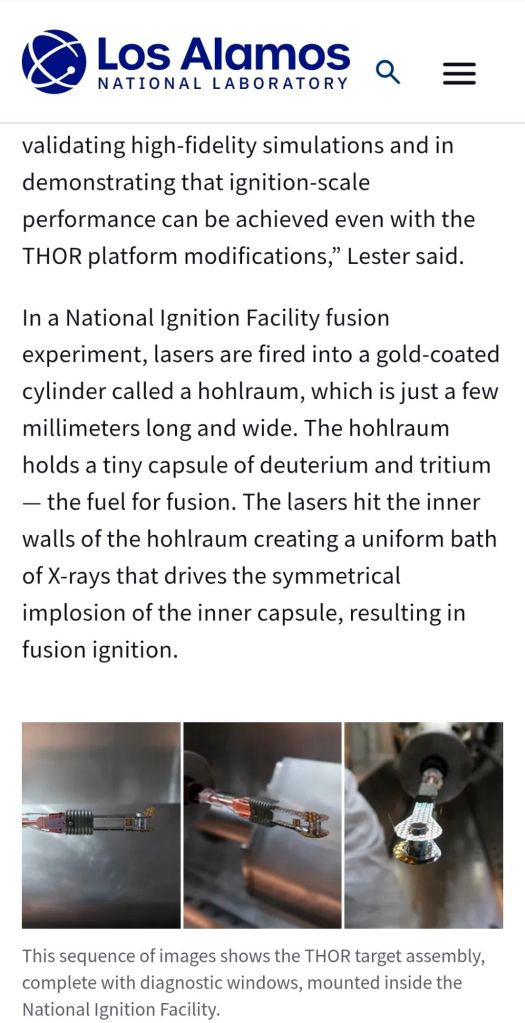
Tokamaks for fusion are able to do a better job than lasers for fusion energy. This is a basic fact and I have had the idea of bringing hohlraums into a plasma for achieving results, but what’s even better is the idea of adding plutonium 239 within the hohlraums together with tritium. This goes together with 80% of depleted uranium powder around the hohlraums.
So here’s the input I used with Gemini :
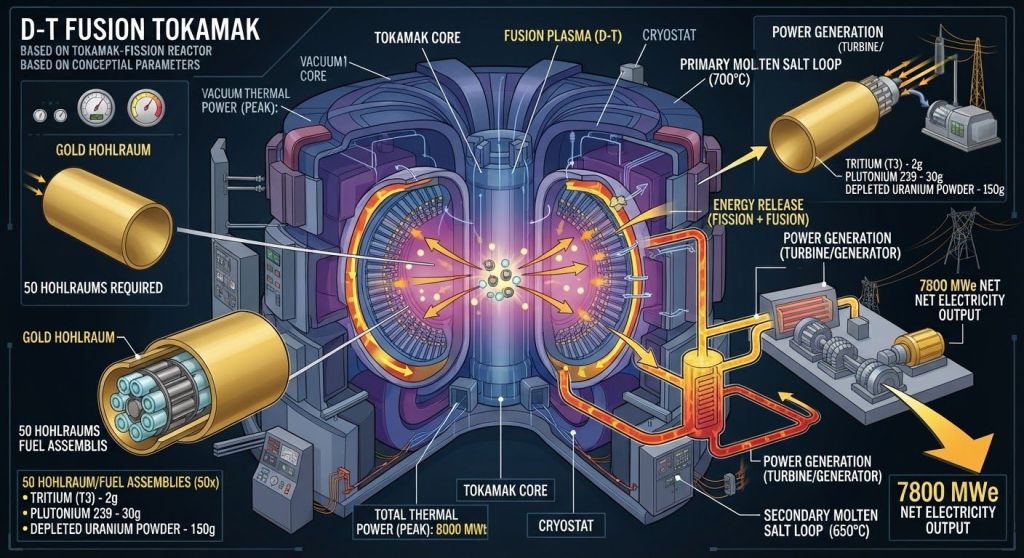
Hello Gemini. Gold hohlraums with tritium within under laser allow to produce some energy through fusion. I argue that by adding within plutonium 239 together with the tritium (2 grams of T3 per hohlraum together with 30 grams of plutonium 239 per gold hohlraum) it is possible, by putting them instead within a fusion tokamak together with depleted uranium powder (150 grams per hohlraum), to produce through transmutation and fission thanks to fusion neutrons in the confined plasma 8000 MWt of energy. 2 loops of molten salts for energy capture would allow to extract 7800 MWe with 50 hohlraums. Can you please draw that ?
Here’s the result :
It’s even possible to use only depleted uranium and achieve even better yields thanks to fast neutron fission of depleted uranium. Indeed depleted uranium can fission directly with the extremely fast neutrons within a tokamak plasma. In this configuration 9 500 MWt is achievable.
It is also possible to increase the yield by using, instead of gold, tungsten or palladium for the hohlraums. There’s a +300% gain with tungsten and +360% for palladium but the cost of palladium leads to the suggestion of using tungsten only. So with depleted uranium and tungsten for the hohlraums (without plutonium 239), the final yield is of 40 000 MWt. 6 loops of molten salt heat capture are needed for converting that into 34 000 MWe (of which 2 000 MWe will be used for the inertial confinment). This makes it imperative nevertheless to ensure a combined cycle of heat capture, for instance by capturing with a 7th loop (sCO2 this time) and using it to preheat natural gas, and with this, it is possible to achieve the following :
- 94,6% energy efficiency of the fusion-fission hohlraum tokamak.
- Powering a natural gas powerplant with two loops of sCO2 heat capture, using the powerful combustion level within, to achieve 71,2% of energy efficiency for the natural gas powerplant and hence 41°C CO2, which is cold, so the final energy efficiency of the combinate (fusion-fission hohlraum tokamak and natural gas powerplant) has a 103,3% energy efficiency, coldening the climate around, while offering 33 200 MWe of electricity output to the electricity distribution system.
The cost would be of 63,4 euros / MWh. A standard subcritical spinning Water motor allows 24 euros / MWh but many people are eager to see tokamaks at work. Fusion combined with fission makes it workable and holhraums improve the energy yield by offering more neutrons for transmutation… basically without fission, for a tokamak it’s 150 000 euros per MWh. Here’s for your “nuclear-free future”, dummies.

